What the Epitalon evidence actually shows
Epitalon is the peptide at the center of the anti-aging and longevity conversation, promising to switch telomerase back on and slow the clock. It is a genuinely bold claim. The evidence behind it is smaller, older, and thinner than the hype suggests.
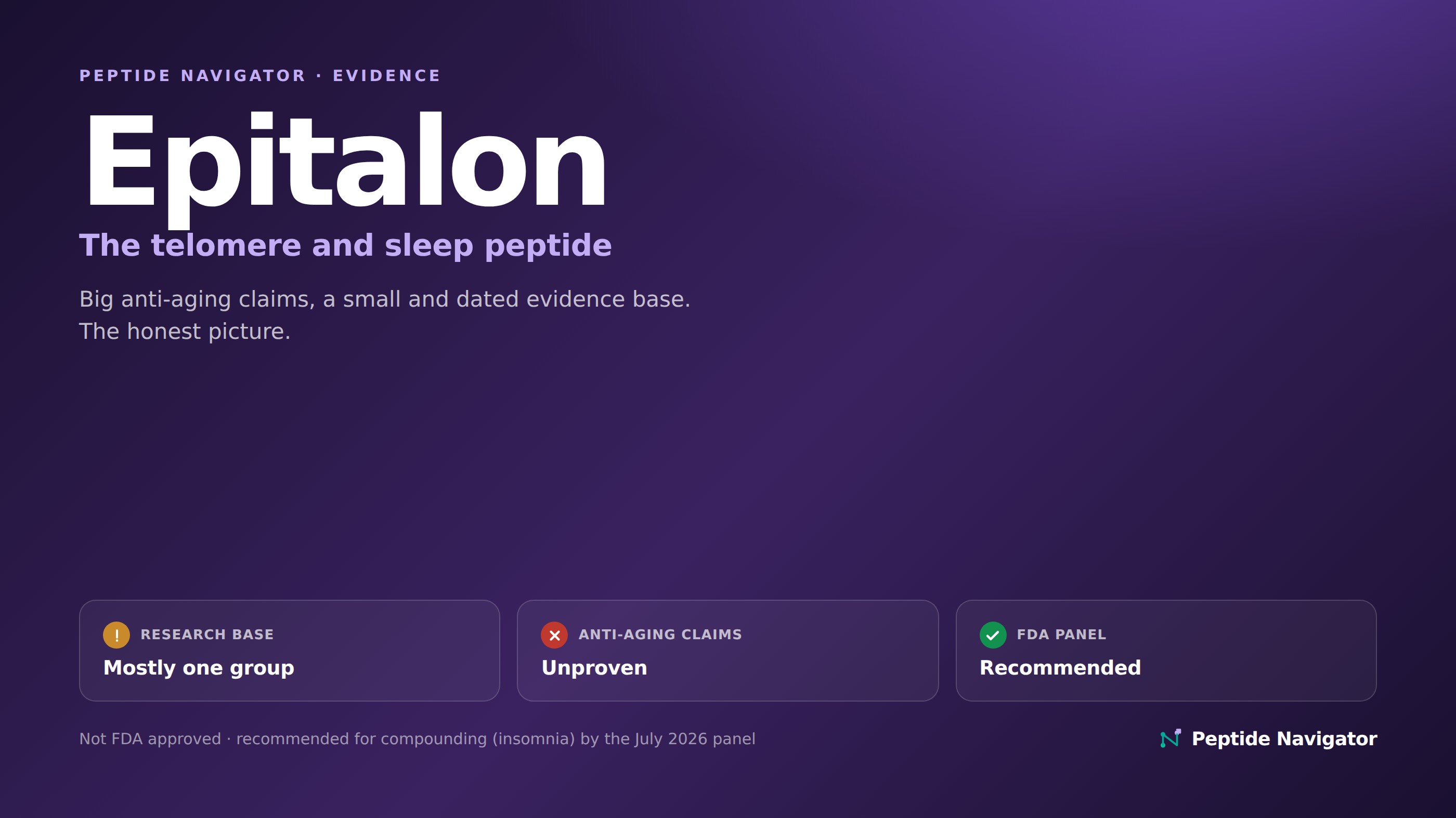
Few peptides promise as much as Epitalon. Search it and you will find talk of longer telomeres, a reset body clock, and even a longer life. Those are extraordinary claims, and extraordinary claims call for a careful look at where the evidence actually comes from.
What is Epitalon (Epithalon)?
Epitalon, also spelled Epithalon, is a synthetic four-amino-acid peptide. It was created in Russia as a copy of a natural substance from the pineal gland, the small brain structure tied to melatonin and sleep-wake rhythms. Its developers proposed that it could activate telomerase, the enzyme that maintains the protective caps on the ends of your chromosomes, and help regulate the body's daily rhythms. That telomere angle is the entire basis of its anti-aging reputation.
Epitalon is a lab-made version of a pineal-gland peptide, promoted mainly for anti-aging and sleep. The idea is interesting. Whether it does any of that in real people is a separate question, and the honest answer is that we do not have strong proof.
Epitalon benefits: what the human evidence actually shows
Start with the mechanism, because that is where the real evidence sits. In laboratory studies, Epitalon has been shown to switch on telomerase and lengthen telomeres in human cells grown in a dish. The original work came from the Russian group that developed the peptide, using telomerase-negative human fetal fibroblasts (Khavinson 2003). More significantly, in 2025 an independent team at Brunel University London reported the same telomerase and telomere-length effect in human cell lines (Al-Dulaimi 2025), which matters because it is a Western replication rather than more from the original source. Both are in-vitro studies in cultured cells, not people. A correction to the 2025 paper was published in November 2025 (correction notice); the paper still stands, but the scope of that correction was not established at the time of writing, so treat the specific figures with that caveat.
The human research is a thinner and separate story, and it is important to be precise about what was actually tested. Almost all of the human trial data is on epithalamin, the natural pineal-gland extract, not on the synthetic Epitalon peptide sold online, and it comes largely from a single Russian group. In a randomized study of 79 elderly patients with coronary disease followed for 15 years, those given repeated courses of epithalamin showed slower cardiovascular aging and were reported to have significantly lower mortality than patients on standard care alone (Korkushko 2011); the abstract gives no mortality figures, so no number should be read into that. A separate randomized trial in healthy elderly people found that epithalamin nudged the melatonin rhythm in a modulatory way, raising night-time melatonin in those who started low and easing it in those already normal (Korkushko 2004). These are small studies from the same research program, several are decades old, they report few hard numbers, and none has been independently replicated in the large controlled trials Western regulators expect.
So here is the honest state of the evidence. No human study has measured telomere length in living people after they took Epitalon. The claims that it lengthens human telomeres, slows aging, or extends lifespan in people are not supported by human outcome data. The lifespan findings people repeat come from animals, flies, mice and rats, not humans. There is no established dose-response in people, and no independent, non-Russian human trial of either the peptide or the extract. As of 2026, Epitalon is a compound with an interesting laboratory mechanism and a human evidence base that has not caught up to the promises made for it.
Did the FDA approve Epitalon in 2026?
Not as a drug, and notably, not for anti-aging. On July 24, 2026, an FDA advisory committee voted to recommend that Epitalon be added to the Section 503A Bulks List, with insomnia as the nominated use, not longevity. That would let licensed compounding pharmacies prepare it with a prescription if the FDA adopts the recommendation. It was a recommendation, not FDA drug approval, and the committee was not endorsing the telomere or lifespan claims. We covered what these votes do and do not mean in the full peptide meeting results.
Anything promoted to switch telomerase back on deserves a careful pause. Telomerase activity is one of the tools cancer cells use to keep dividing, so a compound aimed at that pathway raises a real theoretical safety question, even if it is unproven. Human safety data for Epitalon is limited and old. This is a conversation for a clinician, not a checkout page.
Epitalon side effects and safety
Because the rigorous human studies have not been done, the side effect profile is not well characterized. Reported use tends to describe it as well tolerated, but that comes from small, uncontrolled settings rather than proper safety trials. With so little formal human data, rare or long-term risks have not been measured, and the theoretical telomerase-and-cancer concern above has not been resolved either way.
Is Epitalon legal?
Epitalon is not an FDA-approved drug and has been sold widely as a research chemical, often labeled not for human use, which protects the seller rather than the buyer. The 2026 advisory vote could open a legal compounding pathway through licensed pharmacies if the FDA finalizes it, but that has not happened yet.
The honest bottom line
Epitalon is a case study in the gap between a big story and a small evidence base. The anti-aging and telomere claims are dramatic, and the human evidence behind them rests largely on older work from a single Russian group, even though the laboratory telomerase mechanism has since been independently replicated in cell studies. The FDA panel recommended it for insomnia, not for longevity, which is worth remembering the next time you see it sold as a fountain of youth. If it moves into regulated compounding, that is an improvement over anonymous vials, but it will not turn the claims into proof. For another peptide where a real mechanistic and cosmetic literature runs ahead of the clinical trials, see what the science supports for GHK-Cu.
Know each peptide before you talk to a clinician
We are building plain-English, fully sourced guides across the peptides people actually ask about, evidence and caveats included. Explore what is live now in the library.
Browse the libraryReferences
Every source below was checked at the abstract level; study type and species are stated so each can be weighed honestly.
Khavinson VKh, Bondarev IE, Butyugov AA. Epithalon peptide induces telomerase activity and telomere elongation in human somatic cells. Bull Exp Biol Med. 2003. In-vitro study in telomerase-negative human fetal fibroblasts (cell culture, not people). (PubMed 12937682)
Al-Dulaimi S, Thomas R, Matta S, Roberts T. Epitalon increases telomere length in human cell lines through telomerase upregulation or ALT activity. Biogerontology. 2025. In-vitro study in human cell lines (breast cancer lines 21NT and BT474 plus normal epithelial and fibroblast cells); Brunel University London, an independent Western group. (PubMed 40908429) A correction was published in November 2025 (PubMed 41240216); the paper stands, and the scope of the correction was not established here.
Korkushko OV, Khavinson VKh, Shatilo VB, Antonyk-Sheglova IA. Peptide geroprotector from the pituitary gland inhibits rapid aging of elderly people: results of 15-year follow-up. Bull Exp Biol Med. 2011;151(3):366-9. Randomized controlled study; 79 elderly coronary patients; epithalamin, the pineal-gland extract; 15-year follow-up. (PubMed 22451889)
Korkushko OV, Khavinson VKh, Shatilo VB, Magdich LV. Effect of peptide preparation epithalamin on circadian rhythm of epiphyseal melatonin-producing function in elderly people. Bull Exp Biol Med. 2004;137(4):389-91. Randomized clinical trial; healthy elderly (sample size not reported in the abstract); epithalamin, the pineal-gland extract. (PubMed 15452611)
FDA Pharmacy Compounding Advisory Committee meeting materials, July 23-24, 2026 (FDA.gov).
This article summarizes publicly reported information as of July 2026 and is educational, not medical or legal advice. Epitalon is not approved by the FDA for human use. Regulatory status and evidence can change. Always consult a licensed healthcare professional before making any health decision.