The FDA Peptide Meeting Is Over: Six Advanced, One Did Not. Here Is What Happens Next.
The second day of the FDA's peptide meeting added Epitalon and Semax to the list of substances recommended for compounding, while Emideltide, better known as DSIP, failed to advance. The final result was six favorable recommendations out of seven peptides reviewed.
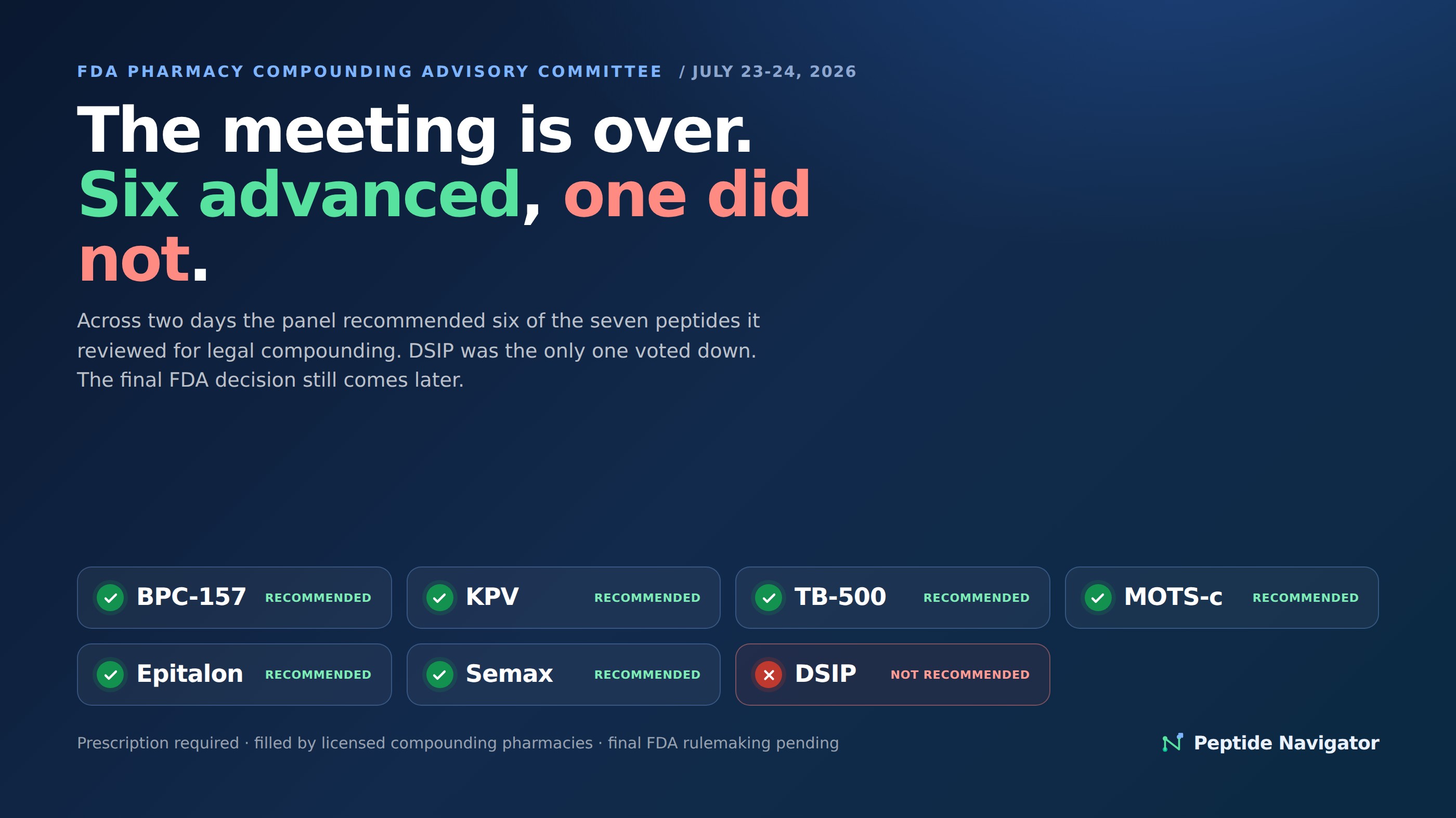
The FDA's Pharmacy Compounding Advisory Committee completed its two-day peptide review on July 24, 2026. On the first day, four substances received favorable recommendations: BPC-157, KPV, TB-500, and MOTS-c. The second day brought three more decisions.
The committee recommended Epitalon and Semax for potential inclusion on the FDA's Section 503A Bulks List. It voted against recommending Emideltide, commonly known as DSIP. That brought the final tally to six favorable recommendations out of seven peptides.
Which peptides did the FDA advisory committee recommend?
Here is the complete outcome of the two-day meeting. Six substances cleared an important advisory hurdle. One did not.
Six peptides were recommended by an FDA advisory committee for possible inclusion on a compounding list. That is not the same as the FDA approving six peptide drugs. The next decision belongs to the FDA.
What happened on Day 2 of the FDA peptide meeting?
On July 24, the committee considered Epitalon, Semax, and Emideltide in their free-base and acetate forms. The FDA reviewed each substance in connection with specific nominated medical uses: Epitalon for insomnia, Semax for cerebral ischemia, migraine, and trigeminal neuralgia, and Emideltide (DSIP) for opioid withdrawal, chronic insomnia, and narcolepsy. Those were the conditions placed before the committee. The votes were not broad endorsements of every claim made about these peptides online or in wellness and longevity clinics.
Epitalon advanced
The committee recommended that Epitalon be considered for inclusion on the 503A Bulks List. Epitalon is widely discussed in anti-aging and longevity communities, particularly in connection with sleep, aging biology, and telomeres. The committee was not deciding whether Epitalon slows aging or extends lifespan. The nominated use it considered was insomnia.
FDA staff had raised concerns about the limited clinical evidence, a lack of adequate safety information for the proposed routes, possible immune reactions, and the peptide aggregation and impurities that can occur during manufacturing. The favorable vote means the committee believed Epitalon should move forward within the compounding framework despite those unresolved questions. It does not mean the questions have been answered.
Semax advanced
The committee also recommended Semax, by a vote of 8 in favor, 5 opposed, and 1 abstention. Semax has been used and studied outside the United States, particularly in Russia and Eastern Europe, and is often promoted for cognition, focus, migraine, and neuroprotection. The FDA review, though, was limited to cerebral ischemia, migraine, and trigeminal neuralgia.
The agency's scientific review concluded that the available evidence was insufficient to establish effectiveness for those conditions, and it flagged limited safety information, product consistency, impurities, aggregation, and possible immunogenicity. The committee voted in favor anyway, allowing Semax to advance toward possible patient-specific compounding.
DSIP did not advance
Emideltide, commonly called delta sleep-inducing peptide or DSIP, was the only substance in the two-day meeting that did not receive a favorable recommendation. The committee voted 6 in favor, 7 opposed, and 1 abstention. Because a majority voted against inclusion, DSIP was not recommended for the 503A Bulks List.
Committee members and FDA reviewers were concerned that the evidence for DSIP was too limited, too old, or not applicable enough to the proposed compounded product. Among the issues were very small human studies, uncontrolled or weak study designs, limited safety data, a mismatch between the route used in available studies and the route proposed for compounding, uncertainty about the precise identity and quality of the finished substance, and the availability of existing approved treatments for insomnia, narcolepsy, and opioid withdrawal. The FDA continues to say it lacks the information to determine whether compounded Emideltide would harm patients through the proposed route.
Why did the committee vote yes despite the FDA's concerns?
FDA staff had advised against including all seven substances, citing limited human evidence, unresolved safety questions, and concerns about manufacturing quality and product identity. The committee rejected that cautious position for six of the seven. So why?
The debate was not really about whether these peptides had completed the same process as an approved pharmaceutical. They have not. The larger policy question was whether patients would be safer getting peptides through licensed physicians and pharmacies than through unregulated online sellers.
People already buy these substances from websites that may label them "research use only." In many cases, buyers have little reliable information about where the ingredient was made, whether the vial actually contains what the label says, whether the concentration is accurate, whether the product is sterile, whether it contains contaminants, whether it was independently tested, or whether it degraded in storage or shipping. Supporters of the favorable votes argued that moving peptide use into a prescription-based compounding system would add accountability, traceability, and medical oversight.
There is one more piece of context worth keeping in view. The committee had been reconstituted shortly before the meeting, and six of the eight members newly appointed in June run clinics that offer peptides, according to ABC News. Critics raised conflict-of-interest concerns, and HHS said the members had cleared its ethics review. That does not invalidate the votes, but with margins this close and the FDA's own scientists on the other side, it is fair context to keep in mind.
The committee did not conclude that the six peptides are scientifically proven. As one member put it, the panel had not approved a finished drug. It was trying to move a decision patients are already making into a system governed by physicians, pharmacists, and regulation. That is the central meaning of the meeting: supervised compounding may be preferable to leaving the market underground.
What happens next after the FDA peptide vote?
The meeting is over, but the regulatory process is not. The recommendations now go back to the FDA, which is the only body with the legal authority to place substances on the permanent 503A Bulks List. The committee cannot do it alone.
The FDA can now accept all six recommendations, accept only some, reject one or more, ask for more information, set restrictions on chemical form or route, require clearer identity and purity standards, issue an interim enforcement policy, or begin formal rulemaking to add the substances to the list. The recommendations are nonbinding. FDA leadership makes the final call.
Could the FDA still reject the peptide recommendations?
Yes. The FDA is not legally required to follow its advisory committee. It could decide the evidence remains inadequate, that manufacturing standards are not sufficiently defined, or that certain routes carry unacceptable risk. It could also reach different conclusions for different peptides, for example allowing one chemical form but not another, restricting injectable preparations, or requiring extra quality controls first. The final action does not have to be an all-or-nothing decision across all six.
Could peptide compounding begin before a final FDA rule?
Possibly, but only if the FDA takes an extra step. One option is an interim enforcement-discretion policy, in which the FDA announces that it does not intend to act against qualifying 503A pharmacies that compound certain peptides under set conditions while permanent rulemaking continues. Those conditions might cover patient-specific prescriptions, approved ingredient manufacturers, certificates of analysis, identity and purity testing, sterility, permitted routes, adverse-event reporting, labeling, physician documentation, and limits on mass production.
No such policy had been announced right after the meeting. So pharmacies should not read the committee vote alone as permission to start broad national distribution.
Why peptide identity and purity may be the biggest obstacle
One of the most important issues raised was not whether patients want access. It was whether regulators can precisely define what each peptide actually is. Peptides can be hard to manufacture consistently, and problems include incomplete or incorrect amino-acid sequences, truncated peptides, aggregation, degradation, residual chemicals, related peptide impurities, differences between free-base and acetate forms, and differences between products sold under the same popular name.
FDA staff warned that meaningful quality requirements cannot be set until the identity of the substance is clearly defined. This matters especially for TB-500, BPC-157, and other products sold by many suppliers under common marketplace names. The FDA could require exact molecular specifications before allowing pharmacies to compound them.
When will the six peptides actually be available?
There is no official availability date. An October 2026 rollout has been floated within the peptide community, but the FDA has not announced any implementation date. The timing depends on which path the agency picks. An interim policy could move faster. Formal rulemaking could take considerably longer, because it may require a proposed rule, a public comment period, review of the comments, a final rule, and an effective date. The next announcement that truly matters will not be another committee vote. It will be an official FDA rule, guidance, or enforcement policy.
How to legally get BPC-157 or TB-500 through a compounding pharmacy
Assume, for a moment, that the FDA does adopt these recommendations. What would getting one of these peptides actually look like? Not like grabbing a bottle off a shelf, and not like the anonymous checkout pages many people use today.
The likely path runs in a straight line. A patient sees a licensed prescriber and is evaluated the way they would be for any other concern. If that clinician decides a compounded peptide is medically appropriate, they write a patient-specific prescription. That prescription goes to a qualified compounding pharmacy rather than a retail counter. The pharmacy reviews it, prepares the formulation, quotes the patient a price, and, if the patient agrees, dispenses or ships it in line with federal and state law. From there, the clinician is responsible for monitoring.
The upside of this model is real. A licensed pharmacy operates under sourcing, testing, recordkeeping, and state regulatory requirements that an anonymous "research use only" website does not. It is a more accountable path. But it is not a guarantee of quality, because compounded products still skip the FDA premarket review that commercial drugs go through, and quality can vary from one pharmacy to the next.
A prescription does not make a therapy proven. It means a licensed clinician judged it appropriate for you and takes responsibility for that call. The evidence questions the FDA raised do not disappear because a script exists. This is a conversation to have with a clinician who knows your history, not a decision to make from a headline.
503A vs 503B: why mass supply is not here yet
There has been a lot of chatter about large compounding operations gearing up to ship enormous volumes. Some context helps here. This vote concerned the 503A Bulks List, and 503A is not designed as an unlimited mass-manufacturing pathway.
Section 503A pharmacies generally require a patient-specific prescription, are overseen mainly by state pharmacy boards, and face limits on interstate distribution and on mass-producing copies of commercial drugs. That is a different world from Section 503B outsourcing facilities, which can make certain products as office stock without an individual prescription, but which must register with the FDA and follow federal manufacturing standards. A favorable 503A vote does not automatically authorize 503B facilities to mass-produce these same peptides as general stock.
So when you read that a pharmacy has the capacity to scale production tenfold, treat that as capacity, not permission. Clean rooms and filling lines can be expanded quickly. The legal authority to ship these peptides at scale still depends on final FDA policy, state law, sourcing rules, and the prescription requirement. Capacity is not the same as a green light.
Will CVS or Walgreens carry compounded peptides?
Most likely not in the way you pick up an ordinary prescription. Major retail pharmacies dispense finished commercial drugs. They do not generally prepare custom sterile peptide medications at the local store. The realistic model is a specialized compounding pharmacy that receives the prescription, prepares the formulation, and ships it to the patient, with a clinician managing care throughout.
Will insurance, Medicare or TRICARE cover peptides?
The idea that insurers will soon cover these is, for now, speculation. The July vote did not create an FDA-approved use, a billing code tied to an approved product, an established price, a Medicare coverage decision, or a TRICARE formulary listing. None of the machinery that insurance runs on was set in motion.
Medicare Part D coverage of compounded products generally depends on whether the individual ingredients independently meet the definition of a covered drug, and an unapproved bulk peptide may not clear that bar. Broader coverage would likely require stronger human evidence, recognized uses, published treatment guidelines, consistent quality standards, and reliable pricing, and possibly an FDA-approved commercial product down the line. The defensible expectation is that access, at least at first, stays largely cash-pay.
Are BPC-157 and TB-500 banned in sports and the military?
A compounded prescription does not override anti-doping rules. BPC-157 and TB-500 have been tied to anti-doping prohibitions, and neither a physician's prescription nor a spot on the 503A list makes them permissible for Olympic, NCAA, or professional athletes, or for service members and others in safety-sensitive roles governed by their own performance-enhancing-drug policies. Medical legality, FDA regulatory status, and anti-doping eligibility are three separate questions. It is entirely possible for something to be legally compounded and still get you sanctioned in your sport or your unit.
Is the FDA peptide decision now up to RFK Jr.?
Not exactly. As HHS Secretary, Robert F. Kennedy Jr. has real policy influence over the FDA and has publicly supported wider peptide access, and this recommendation lines up with that stance, which makes favorable action more likely. But the formal decision runs through the FDA and HHS administrative process, involving agency leadership, lawyers, and regulatory staff, and potentially formal rulemaking. The advisory committee advises the FDA. It does not hand the matter to the Secretary for a personal yes or no.
Are the six peptides FDA approved now?
No. The six peptides were recommended for possible inclusion on a compounding list, which is different from FDA approval of a drug. A conventionally approved drug has been through formal FDA review of its clinical evidence, safety, effectiveness, manufacturing, labeling, dosing, contraindications, quality controls, and risk-benefit balance. The six peptides did not get that through this meeting. Even if the FDA eventually permits them to be compounded, medications made from them would remain compounded, unapproved drug products.
The accurate wording is that six peptides were recommended by an FDA advisory committee for potential inclusion on the Section 503A Bulks List. The inaccurate wording is that the FDA approved six peptide drugs.
Can DSIP be reconsidered?
Yes, but reconsideration is not automatic. The July 24 vote did not permanently ban DSIP, and it does not stop the substance from ever being reviewed again. A company, physician, pharmacist, or organization could submit a new or amended nomination with stronger evidence, such as better-controlled human trials, more complete safety data, clearer dosing, route-specific evidence, better manufacturing specifications, precise chemical identification, stability data, impurity testing, and evidence of a clinical need not met by approved medicines.
New clinical research could also prompt reconsideration, and a future committee could review DSIP again if the FDA decides new evidence warrants it. That said, a different FDA conclusion looks less likely here, because both FDA staff and a majority of the committee opposed DSIP. No reconsideration meeting has been announced, and DSIP does not automatically return for another vote.
What about peptides that were not reviewed, like CJC-1295 and GHK-Cu?
The July meeting covered only the seven nominated substances. It did not decide the future of every peptide affected by the FDA's earlier compounding restrictions. Frequently discussed substances including CJC-1295, ipamorelin, thymosin alpha-1, AOD-9604, GHK-Cu, LL-37, and Selank were not placed before the committee at this meeting. They did not fail a vote on July 23 or 24. They simply were not on the agenda. They could be considered in future proceedings if they receive complete nominations and the FDA schedules them, though many remain listed by the FDA as substances presenting significant or unresolved safety concerns.
Know each peptide, honestly
Our plain-English guides lay out what the evidence actually shows for BPC-157, TB-500, Epitalon, and more, caveats included, so you walk into that appointment informed rather than sold.
Browse the libraryThe bigger picture: a shift in peptide policy
The most important result of the two days may not be the number six. It may be the philosophy the majority expressed. For years, peptide policy has largely been built around restricting access because these substances lack the evidence required for conventional approval. The committee took a different path. Its majority decided the existing gray market cannot be ignored, and that patients may be better protected when peptide use runs through a licensed prescriber, a patient-specific prescription, a licensed compounding pharmacy, documented sourcing, quality testing, professional counseling, medical follow-up, and adverse-event reporting. That does not erase the scientific uncertainty around these substances. It creates a possible way to manage that uncertainty inside a regulated system.
Bottom line: what the FDA peptide vote means for patients
The July 23 and 24 meeting produced a clear result. Six peptides advanced, and one did not. BPC-157, KPV, TB-500, MOTS-c, Epitalon, and Semax received favorable recommendations. Emideltide, or DSIP, did not. None of the six is yet a conventionally FDA-approved drug, and none became automatically available just because of the vote.
The FDA must now decide whether to accept the recommendations, set conditions, issue an interim policy, or complete formal rulemaking. DSIP can potentially return later, but only if new evidence or a stronger nomination provides another opening. The advisory phase is complete. The next phase decides whether these votes turn into real legal access for physicians, pharmacies, and patients. We will update our FDA Peptide Watch the moment the FDA acts.
Follow the story as it develops
We track every step of this process and update the moment the FDA acts. Explore our full library of evidence-first guides at peptidenav.com.
Sources and further reading
FDA, Pharmacy Compounding Advisory Committee meeting materials, July 23-24, 2026 (FDA.gov). Day two reporting on the Epitalon and Semax recommendations and the DSIP rejection: STAT and RAPS. FDA background on compounding and the Section 503A Bulks List (FDA.gov).
This article summarizes publicly reported information as of July 24, 2026 and is educational, not medical, legal, or financial advice. Many peptides discussed are not approved by the FDA for human use. Regulatory status can change quickly. Always consult a licensed healthcare professional before making any health decision.