What the TB-500 evidence actually shows
TB-500 is one of the most popular recovery peptides on the internet, and like BPC-157, one of the least tested in humans for the reason people actually use it. Here is the honest picture: deep animal data, a real but narrow human record for the parent molecule, and no completed trial for the muscle-and-tendon recovery it is sold for.
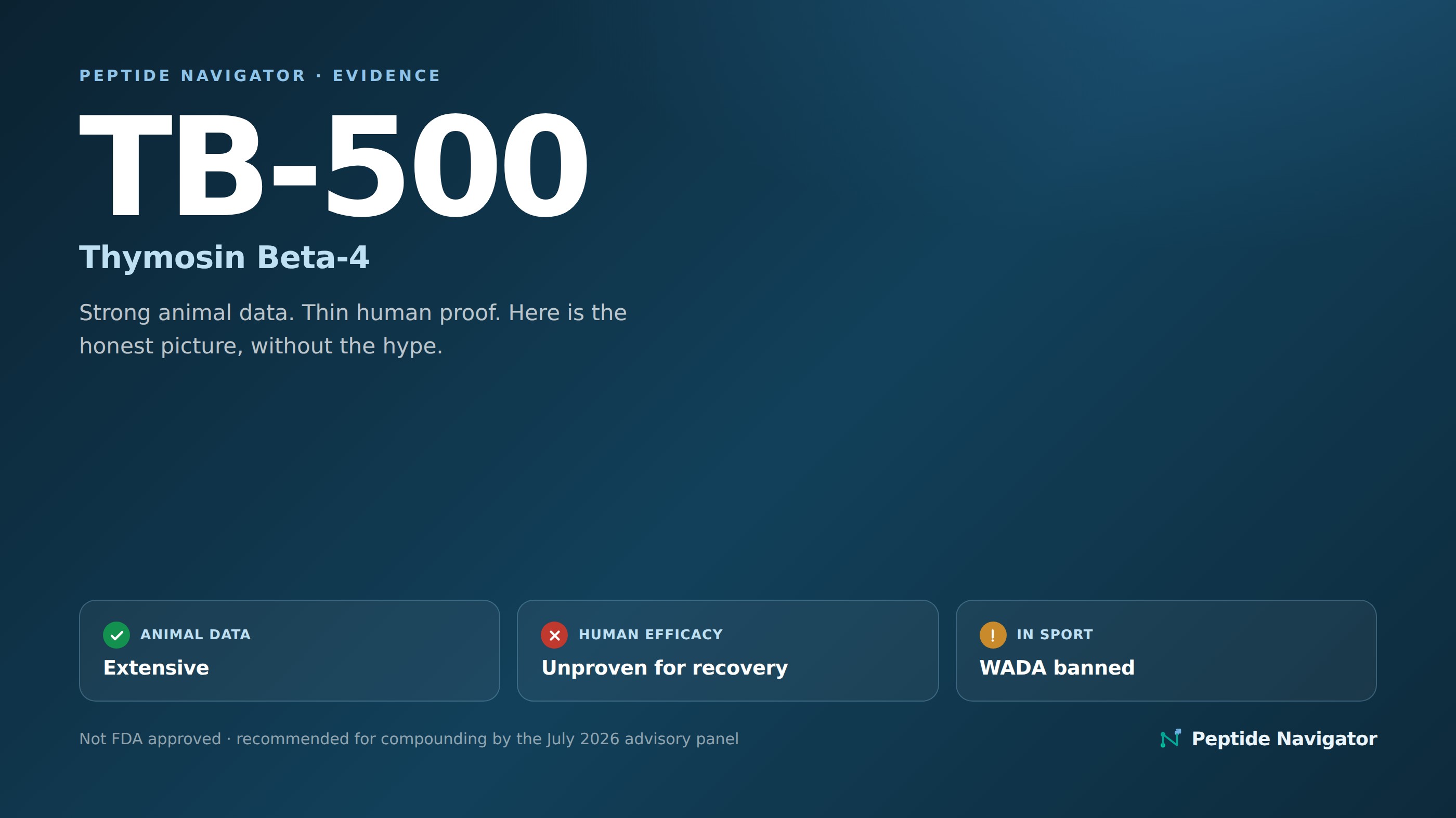
Search TB-500 and you will find confident promises about healing tendons, recovering from injury faster, and bouncing back like new. The biology behind those claims is real and interesting. The human proof behind them, for the way most people use TB-500, is close to nonexistent. Both of those things are true at once, and the honest version of this peptide lives in that gap.
What is TB-500 (thymosin beta-4)?
TB-500 is a synthetic peptide marketed as a version of thymosin beta-4, a naturally occurring protein found in nearly every cell in the body. Thymosin beta-4 plays a central role in regulating actin, a building block of cells, which makes it important for cell movement, wound repair, new blood vessel formation, and inflammation control. On paper, that is a strong rationale for a recovery compound, which is exactly why TB-500 has such a following.
One wrinkle worth knowing: products sold as TB-500 are not always the same thing. Some contain full thymosin beta-4, others a shorter active fragment, and quality varies between sellers. That ambiguity about what is actually in the vial is one of the exact concerns the FDA raised during its 2026 review.
Thymosin beta-4 is a real molecule with real biology. TB-500 is what the market calls the injectable version sold for recovery. The science of the molecule and the evidence for the product are not the same thing.
TB-500 benefits: what the human evidence actually shows
The animal literature is genuinely large. In rodents and other models, thymosin beta-4 has shown effects on wound healing, tendon and muscle repair, corneal healing, and even cardiac tissue after injury. That is the foundation the marketing is built on.
The human record is much thinner, and the single most important fact about it is a naming problem. The large body of research people cite for TB-500 is almost all about thymosin beta-4, the parent molecule, which is not the same thing as the synthetic fragment sold as TB-500. On PubMed, thymosin beta-4 returns over a thousand papers, while TB-500 itself returns around two dozen. Filter TB-500 to completed human clinical trials or randomized controlled trials and the count is zero.
The parent molecule does have human trials, but for other conditions. Thymosin beta-4 has been tested in people mostly for eye and skin problems, developed as a drug candidate under the name RGN-259 for dry eye disease, and studied for slow-healing venous ulcers, roughly seven human randomized trials in total. Those are the human uses on record. None of them is the muscle, tendon, or athletic recovery that TB-500 is actually sold for, and for that use there are no completed randomized, placebo-controlled human trials at all.
As for the TB-500 fragment itself, as of September 2026 exactly one clinical trial worldwide is registered to administer it to people: a recruiting study in Shenzhen, China, measuring cardiovascular biomarkers in stable cardiovascular disease, with no results posted (ClinicalTrials.gov NCT07487363). One trial, for heart biomarkers, not tendon repair.
Did the FDA approve TB-500 in 2026?
Not as a drug. On July 23, 2026, an FDA advisory committee voted to recommend that TB-500 be added to the Section 503A Bulks List, with wound healing as the nominated use. That would let licensed compounding pharmacies prepare it with a prescription, if the FDA adopts the recommendation. It was a recommendation, not FDA drug approval, and it came over the objection of the FDA's own scientists, who flagged limited human evidence and unresolved questions about safety and product identity. We covered exactly what the vote does and does not mean in the full FDA peptide meeting results.
Human safety data for injectable TB-500 used for recovery is very limited, so its real side effect profile is not well understood. A recurring theoretical concern with growth and repair peptides is their effect on existing tumors, because the same signals that help tissue heal, cell growth and new blood vessels, are signals cancers can use. That is not proof of harm, but it is a real reason to involve a physician rather than a forum.
TB-500 side effects and safety: is it actually safe?
The honest answer is that nobody can say for sure, because the studies needed to say it have not been done in the people using it. Reported side effects from user communities tend to be mild, things like fatigue or head rush after dosing, but self-reported anecdotes are not safety data. With so few people formally studied for this use, rare or long-term risks simply have not been measured. As with BPC-157, absence of reported harm in tiny or uncontrolled settings is not the same as proven safety.
Is TB-500 legal, and is it banned in sports?
TB-500 is not an FDA-approved drug. It has been sold widely as a research chemical, often labeled not for human use, which is a legal shield for the seller rather than a safety statement. The 2026 advisory vote could open a legal compounding pathway through licensed pharmacies if the FDA finalizes it, but that has not happened yet.
On the sports side, the answer is clear and often missed. TB-500 and thymosin beta-4 are prohibited at all times by the World Anti-Doping Agency. A prescription or a place on the compounding list would not change that. For any tested athlete, in the Olympics, the NCAA, or professional leagues, and for service members under performance-enhancing-drug policies, TB-500 can end a career regardless of its FDA status. It has also long been banned in horse racing.
TB-500 vs BPC-157: what is the difference?
These two get mentioned together constantly, often stacked, and they share a profile: heavy animal data, thin human evidence, huge followings, and a favorable FDA panel vote in July 2026. The difference is origin and emphasis. TB-500 comes from thymosin beta-4 and is studied mostly for tissue, wound, and vascular repair. BPC-157 is derived from a protein in stomach acid and is studied more for gut protection and tendon healing. Neither is a proven, FDA-approved therapy, and combining them, which many people do, has never been formally studied for safety. If you want the honest breakdown of the other one, read what the BPC-157 evidence actually shows.
The honest bottom line
TB-500 sits in the same place as a lot of the peptides having a moment right now. The biology is real, the animal data is real, and the human proof for the popular use is missing. It is not a scam, and it is not a proven therapy. It is an open question wrapped in confident marketing. The 2026 FDA vote may bring it into a regulated, prescription-based system, which would be a real improvement over anonymous websites, but it will not change the underlying evidence or the anti-doping rules. The most useful thing you can do is understand the gap clearly and bring it to a licensed clinician, not a checkout page.
Know each peptide before you talk to a clinician
We are building plain-English, fully sourced guides across the peptides people actually ask about, evidence and caveats included. Explore what is live now in the library.
Browse the libraryReferences
Study counts below were confirmed on PubMed using its clinical-trial and randomized-controlled-trial filters as of September 2026; the interventional trial was read from its ClinicalTrials.gov record. TB-500 and thymosin beta-4 are related but not identical molecules, and the human trial record belongs to the parent molecule.
ClinicalTrials.gov, identifier NCT07487363. TB-500 (Thymosin Beta 4 17-23 Fragment) for Cardiovascular Biomarkers in Stable ASCVD. Interventional trial; Shenzhen, Guangdong, China; status recruiting; no results posted as of September 2026. (ClinicalTrials.gov NCT07487363)
PubMed literature counts as of September 2026: thymosin beta-4, over 1,000 papers and roughly 7 human randomized trials (for dry eye and venous ulcers); TB-500, about 26 papers and zero completed human clinical trials. Thymosin beta-4 clinical development for eye and wound conditions ran under the RGN-259 program.
World Anti-Doping Agency Prohibited List: thymosin beta-4 and related growth factors, prohibited at all times.
FDA Pharmacy Compounding Advisory Committee meeting materials, July 23-24, 2026 (FDA.gov).
This article summarizes publicly reported information as of July 2026 and is educational, not medical or legal advice. TB-500 is not approved by the FDA for human use, and it is banned in sport. Regulatory status and evidence can change. Always consult a licensed healthcare professional before making any health decision.