Andrew Huberman on BPC-157: Does It Really Work?
Andrew Huberman finds BPC-157 interesting enough that he has publicly acknowledged using it himself for strains. But the neuroscientist and Huberman Lab host is also unusually clear about the other side of the story: most of the compelling BPC-157 research is still in animals, rigorous human evidence remains scarce, and long-term safety has not been established.
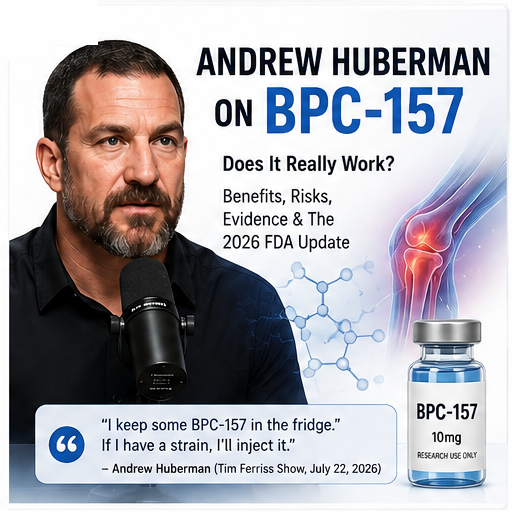
That combination, promising biology, dramatic animal research, growing real-world use and major unanswered human questions, is exactly why BPC-157 has become one of the most talked-about peptides in recovery and regenerative medicine.
So what does Huberman actually say about BPC-157? Why has he used it? And does the science support the hype?
What has Andrew Huberman actually said about BPC-157?
Huberman has discussed BPC-157 repeatedly rather than making a single passing reference to it.
In his April 2024 Huberman Lab episode, "Benefits and Risks of Peptide Therapeutics for Physical and Mental Health," he devoted substantial attention to BPC-157, including its potential role in tissue repair, angiogenesis, administration, sourcing and safety.
Later that year, Huberman hosted physician Craig Koniver for a broader discussion of peptide and hormone therapies. BPC-157 was specifically discussed in connection with inflammation, injury repair, injectable versus oral administration and sourcing.
In June 2026, Huberman returned to the subject in considerable depth with physician Abud Bakri. Their discussion covered the history of BPC-157, animal research, regeneration, clinical evidence, adverse events, gray-market peptides, angiogenesis, tumor concerns, FDA regulation and patient experiences.
And in July 2026, Huberman made the discussion much more personal during an appearance on The Tim Ferriss Show (episode #876, July 22, 2026).
His overall position across these conversations has been remarkably consistent. BPC-157 is scientifically interesting. The animal evidence is compelling enough to take seriously. Anecdotal experiences, including his own, are intriguing. But those things are not the same as proving that BPC-157 works safely and reliably in humans.
Does Andrew Huberman personally use BPC-157?
Yes. This is important because some online articles describe Huberman only as someone who has "discussed" BPC-157.
In July 2026, Huberman told Tim Ferriss:
That is a direct first-person acknowledgement of personal use. Huberman has also previously described experimenting with subcutaneous BPC-157 and perceiving faster healing.
But there is an important distinction between his position and some of the more aggressive peptide protocols promoted online. He has not described BPC-157 as something he continuously takes every day as a general wellness supplement. His description is closer to selective, injury-related use.
He also acknowledges a major problem with his own experience: it is an anecdote. If an injury improves after using BPC-157, there is no untreated version of the same injury available for comparison. Rest, time, rehabilitation and normal healing are happening simultaneously. So his experience is interesting. It is not a clinical trial.
Why does Huberman think BPC-157 may help injuries heal?
The scientific interest in BPC-157 is not based solely on athlete testimonials. There are biological mechanisms that could plausibly explain some of the effects observed in laboratory and animal studies.
One of the most important involves fibroblasts. Fibroblasts are cells involved in producing and remodeling extracellular matrix and collagen, critical components of connective tissues such as tendons and ligaments. Laboratory research has found that BPC-157 can increase migration of tendon fibroblasts and influence cellular pathways associated with tissue repair.
Another proposed mechanism involves angiogenesis, the development of new blood vessels. Damaged tissue needs oxygen, nutrients and cellular resources to repair itself, and increasing vascularization around an injury could theoretically help create an environment favorable to healing. Researchers have also explored possible interactions involving VEGF signaling, nitric oxide pathways and growth-hormone-receptor expression.
This leads to the basic hypothesis:
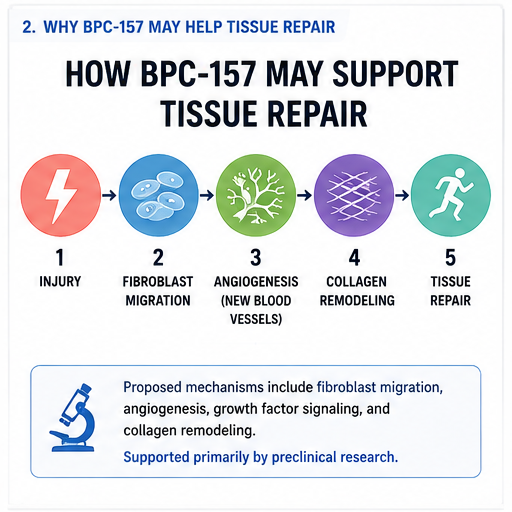
That is a biologically interesting hypothesis. It is also important to recognize what it is not. It is not proof that injecting BPC-157 into a human with tendonitis will reliably accelerate recovery.
What does animal research show about BPC-157?
This is where BPC-157 becomes genuinely interesting.
A frequently cited 2003 study investigated rats with transected Achilles tendons. Researchers reported that animals treated with BPC-157 showed improvements in tendon healing, including biomechanical, histological and functional measures.
A 2011 study looked at how BPC-157 might produce those effects. In rat Achilles tendon explants and cultured tendon fibroblasts, BPC-157 increased tendon fibroblast outgrowth, cell survival, and migration, and the researchers identified the FAK-paxillin pathway as one mechanism involved (Chang 2011). This is in-vitro, preclinical work in rat tissue, not human evidence.
Other preclinical research has investigated BPC-157 in models involving:
- tendon-to-bone healing
- ligament injuries
- muscle damage
- gastrointestinal injury
- ulcers
- bone healing
- wound repair
- blood-vessel formation
- neurological injury
Taken together, the preclinical literature explains why athletes, physicians, biohackers and researchers became interested in BPC-157. There is a recurring biological signal.
But there is also a major limitation: rats are not humans. Animal models are valuable for determining whether something deserves further investigation. They cannot establish that the same magnitude of benefit, or the same safety profile, will occur in people.
Does BPC-157 actually work in humans?
This remains the biggest unanswered question. Despite the enormous popularity of BPC-157, the published human evidence is remarkably small compared with the attention surrounding it.
A small retrospective report involving chronic knee pain described improvement among some patients receiving intra-articular BPC-157, sometimes combined with another peptide. The study was uncontrolled, unblinded and based on a very small patient population.
A later small pilot investigated BPC-157 in women with interstitial cystitis and reported improvement, but again lacked the kind of randomized placebo-controlled design needed to establish efficacy.
A 2025 report involving only two healthy adults examined intravenous BPC-157 and reported no measurable adverse effects in the biomarkers studied after administration. Two people, however, cannot establish a drug's safety.
Other early human work involving gastrointestinal conditions has been referenced, but complete published data remain limited. Most importantly, there still is not a large body of high-quality randomized human trials demonstrating that BPC-157 heals tendon, ligament or muscle injuries.
That may finally begin changing. A randomized, double-blind, placebo-controlled Phase 2 study has been registered to investigate BPC-157 in people with acute Grade II hamstring strains, with planned enrollment substantially larger than previous human reports. That kind of study is precisely what the BPC-157 field has been missing.
BPC-157 evidence scorecard
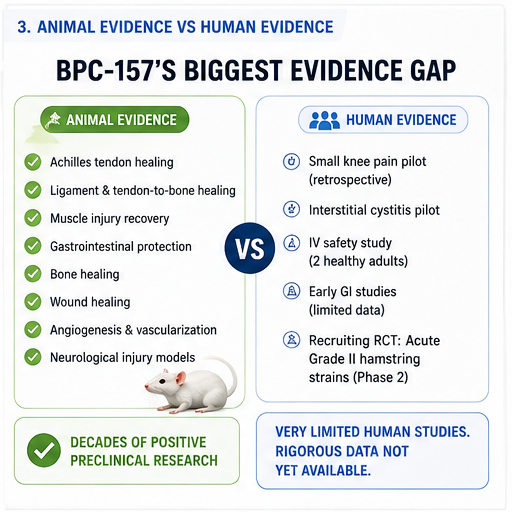
The fairest description is therefore not "BPC-157 does not work." It is this: BPC-157 has interesting and repeatedly positive preclinical evidence, but human medicine has not yet produced the clinical evidence needed to determine how well it works. We go deeper into that in our full BPC-157 evidence guide.
What does Huberman say about BPC-157 side effects?
Safety is one of the most important parts of Huberman's discussion, and there is an interesting indication that audiences care about it: the Huberman Lab question system shows thousands of people asking specifically about BPC-157 side effects.
His concerns generally fall into two categories.
The first is the molecule itself. We simply do not have enough long-term human data to characterize all potential adverse effects, interactions or consequences of repeated exposure.
The second is what is actually inside the vial. Huberman has repeatedly distinguished regulated pharmacy sourcing from peptides obtained through gray-market or research-chemical suppliers. With an unregulated product, the problem is not merely whether BPC-157 works. The product may contain the wrong concentration, impurities, contaminants, bacterial endotoxins or something different from what its label claims. That makes product quality one of the most practical risks in the current peptide market, a point we cover in know your source.
Does BPC-157 increase cancer risk?
This is one of the most misunderstood parts of Huberman's discussion. Huberman has not established that BPC-157 causes cancer.
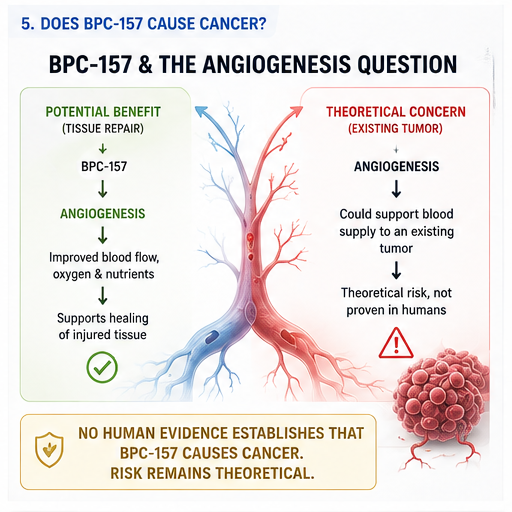
The concern comes from angiogenesis. Remember why angiogenesis could theoretically help an injury: damaged tissue can benefit from increased vascularization. Tumors can also exploit blood-vessel formation to obtain oxygen and nutrients. That creates a theoretical concern that a strongly pro-angiogenic compound might potentially support vascularization of an already-existing tumor.
That is biologically different from saying "BPC-157 causes cancer." There is currently no convincing human evidence demonstrating that BPC-157 causes cancer. There also is not sufficient long-term human evidence to dismiss every possible concern. This is precisely why Huberman tends to put an asterisk beside the angiogenesis discussion: a mechanism that may be beneficial in one biological context could theoretically be undesirable in another.
Did Huberman's view of BPC-157 change between 2024 and 2026?
Not dramatically. What changed was the depth of the conversation.
In 2024, Huberman concentrated heavily on mechanisms, animal evidence, administration, sourcing, cycling and the angiogenesis question. By his June 2026 discussion with Abud Bakri, the conversation had expanded into manufacturing quality, gray and black markets, clinical experiences, physician liability, regulatory questions and the severe shortage of formal human studies. Then, in July 2026, Huberman publicly confirmed his own limited personal use.
So his position has not shifted from skeptic to believer or believer to skeptic. A better description is interested but evidence-conscious. He appears sufficiently persuaded by the biological rationale and his personal experience to selectively use BPC-157 himself, while simultaneously acknowledging that the scientific standard required to establish efficacy in humans has not been met. That nuance is important.
Is BPC-157 FDA approved in 2026?
No. BPC-157 is not FDA approved for any medical indication.
However, something important happened in July 2026 that has generated considerable confusion online. The FDA's Pharmacy Compounding Advisory Committee evaluated BPC-157 and several other peptide-related substances for possible inclusion on the 503A Bulk Drug Substances List. FDA staff recommended against inclusion of BPC-157, citing problems including insufficient safety and efficacy information. The advisory committee nevertheless voted 8-6, with one abstention, to recommend inclusion.
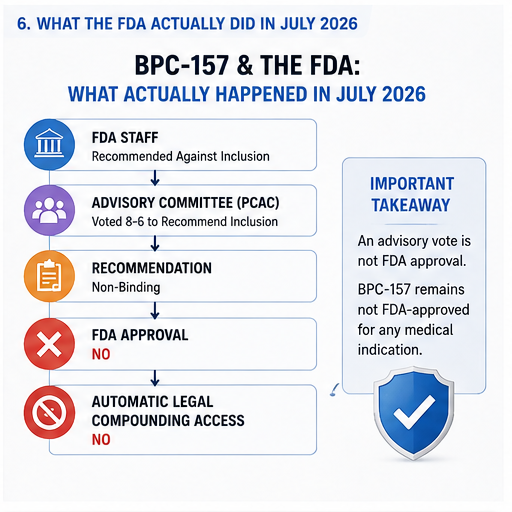
That was significant. It was not FDA approval. An advisory committee recommendation is not a final agency determination, and the vote did not instantly make BPC-157 an approved prescription medication or automatically legalize unrestricted compounding. The FDA itself stated before the meeting that it would not make a final determination until advisory input and its reviews were complete. We covered that vote in detail in our FDA peptide meeting results.
So as of August 2026: an FDA-approved BPC-157 drug? No. Interesting regulatory movement? Yes. Final resolution of the compounding question? Not yet.
Why are people using BPC-157 if human evidence is so limited?
Because medicine does not always develop in a neat sequence. In the case of BPC-157, there is a combination of factors driving interest:
- decades of positive animal research
- plausible tissue-repair mechanisms
- athlete and patient anecdotes
- physician experience
- influencer attention
- increasing public awareness of peptides
- frustration with slow-healing tendon and ligament injuries
For someone dealing with chronic tendonitis or a persistent muscle injury, the possibility of faster recovery is understandably attractive. Huberman's own experience illustrates that attraction. But widespread use does not substitute for randomized trials. It creates a reason to conduct them.
What do we not know about BPC-157 yet?
Quite a lot. Researchers still need good human data answering fundamental questions:
- Does BPC-157 meaningfully accelerate human tendon, ligament or muscle healing?
- Which injuries respond, if any?
- What dose produces a clinically meaningful effect?
- Does route of administration matter, and does injecting near an injury beat systemic dosing?
- How long should treatment last?
- What happens with repeated or long-term exposure?
- Are there meaningful interactions with medications or other peptides?
- Does angiogenesis create clinically relevant risks in people with existing or undiagnosed tumors?
- What adverse effects appear when thousands of people are studied rather than dozens?
These are not reasons to dismiss BPC-157. They are reasons to study it properly.
Want to find out more about BPC-157?
Our BPC-157 guide breaks the evidence down in plain English: what the research really shows, the risks, the sourcing traps, and where it stands with the FDA.
Read the BPC-157 guideSo, does Andrew Huberman think BPC-157 works?
Huberman's public position is more interesting than a simple yes or no. He clearly takes BPC-157 seriously. He has repeatedly devoted substantial time to explaining its mechanisms and research, interviewed physicians who use peptides clinically, described the animal evidence as noteworthy, and most significantly acknowledged keeping BPC-157 available and personally using it when he has a strain.
At the same time, he repeatedly returns to the same limitation: the quality of human evidence has not caught up with the popularity of the peptide. That may be the most accurate description of BPC-157 in 2026. It is neither the proven miracle compound portrayed by some online sellers nor a molecule with no scientific basis.
There is legitimate science here. There are intriguing biological mechanisms. There are compelling animal experiments. There are physicians and patients reporting positive experiences. And now there are early attempts to build the human clinical evidence needed to determine whether those observations translate into reliable medicine.
For Peptide Navigator, that is where BPC-157 becomes worth watching: not because the scientific debate is finished, but because it is finally beginning to move from anecdotes and animal models toward the human studies capable of answering the questions people have been asking for years.
This article is provided for informational and educational purposes only. It is not medical advice and should not be used to diagnose, treat or prevent any condition. BPC-157 is not FDA approved for any medical indication. Decisions involving experimental peptides should be discussed with an appropriately qualified healthcare professional.
Read more and follow along
Explore the full library of evidence-first peptide guides, free articles, and tools at peptidenav.com, including our peptide and compound reference. For the latest peptide research, FDA developments, and honest breakdowns:
Sources and further reading
- Cerovecki T, et al. BPC 157 improves ligament healing in rats. pubmed.ncbi.nlm.nih.gov
- Chang CH, Tsai WC, Lin MS, Hsu YH, Pang JH. The promoting effect of pentadecapeptide BPC 157 on tendon healing involves tendon outgrowth, cell survival, and cell migration (FAK-paxillin pathway). In-vitro, rat Achilles tendon. J Appl Physiol (1985). pubmed.ncbi.nlm.nih.gov
- Lee E, et al. Intra-Articular Injection of BPC 157 for Multiple Types of Knee Pain (retrospective). pubmed.ncbi.nlm.nih.gov
- Lee E, et al. Safety of Intravenous Infusion of BPC157 in Humans (two healthy adults, 2025). pubmed.ncbi.nlm.nih.gov
- McGuire FP, et al. Regeneration or Risk? A Narrative Review of BPC-157. pubmed.ncbi.nlm.nih.gov
- Huberman Lab. Benefits and Risks of Peptide Therapeutics for Physical and Mental Health (2024). hubermanlab.com
- The Tim Ferriss Show, episode #876, "Dr. Andrew Huberman - Peptides, Performance, and Protocols" (July 22, 2026). tim.blog (transcript)
- FDA. Bulk Drug Substances Used in Compounding Under Section 503A. fda.gov
- FDA. Certain Bulk Drug Substances That May Present Significant Safety Risks. fda.gov
This article summarizes publicly reported statements and research as of August 2026 and is educational, not medical or legal advice. Personal anecdotes are not evidence of effectiveness. Always consult a licensed healthcare professional.