What the Semax evidence actually shows
Semax is a peptide with an unusual resume: an approved medicine in Russia, a cult nootropic everywhere else, and almost no presence in Western clinical trials. That split is the whole story, and it is the key to reading the claims honestly.
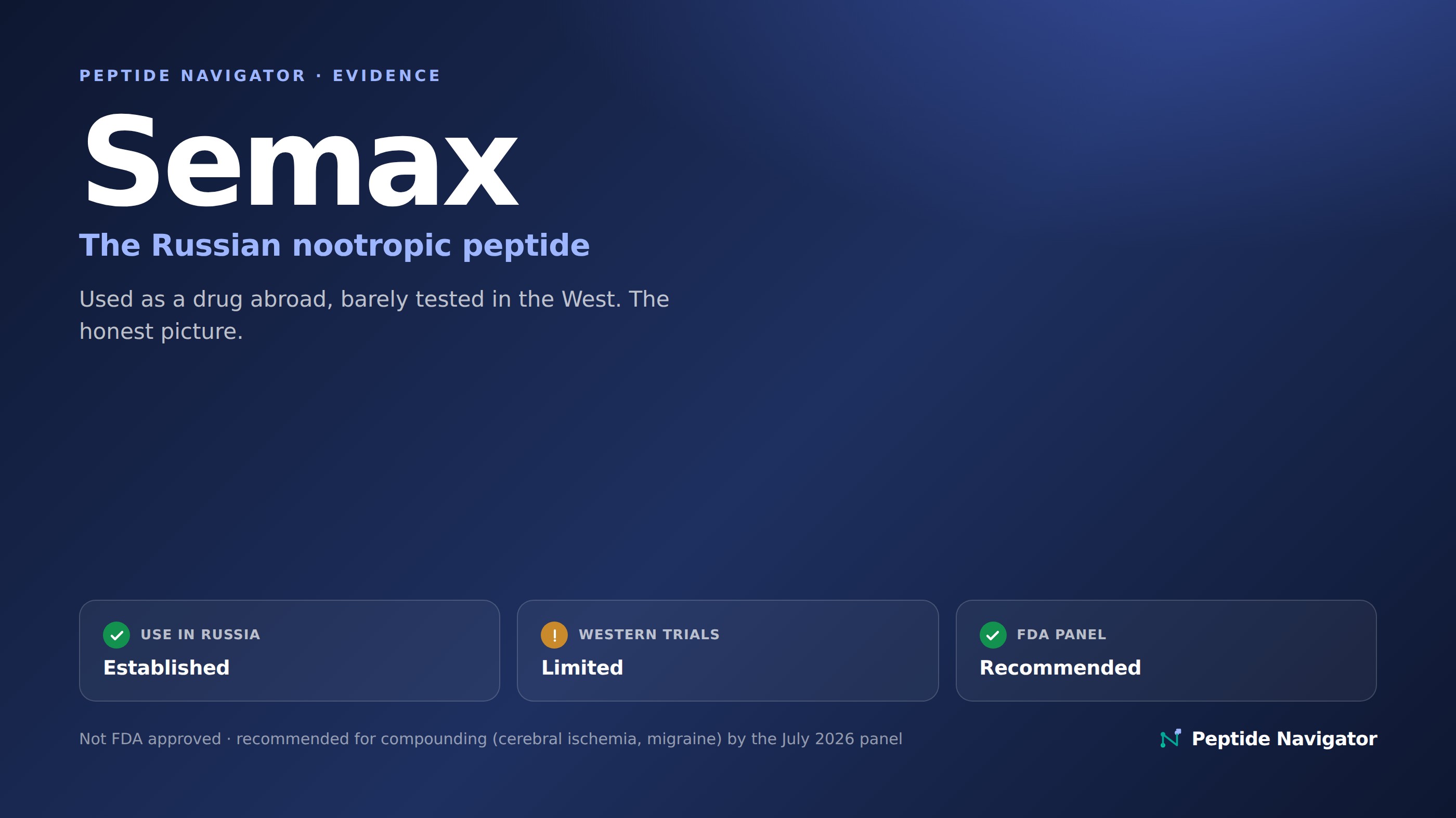
Most peptides in this wave have thin evidence everywhere. Semax is different. It has a decades-long track record as a prescribed drug in one part of the world, and almost nothing to show for itself in the rigorous, independent trials that regulators elsewhere rely on. Understanding that gap is how you avoid both overhyping it and dismissing it.
What is Semax?
Semax is a synthetic peptide developed in Russia, based on a small fragment of a natural brain-signaling hormone with a stabilizing tail added so it lasts longer in the body. It is usually given as nasal drops. In Russia it has been used medically for years for conditions like stroke recovery and cognitive problems, and it is best known internationally as a nootropic, a compound taken for focus, memory, and mental clarity.
Semax is a real, approved medicine in Russia. That is not the same as being proven to the standard the FDA and other Western regulators require. Approval in one country does not automatically mean strong global evidence.
Semax benefits: what the human evidence actually shows
There is genuinely more human use behind Semax than behind most peptides in this group, but two specifics decide how to read it. First, the human trials that exist are almost entirely in Russian-language journals from its country of origin. Filter PubMed to human clinical trials of Semax and the count is about four, and their subjects are ischemic stroke, motor neuron disease, and optic nerve disease, not the focus and memory use it is sold for. Second, Semax has never entered the international clinical trials registry: a search of ClinicalTrials.gov as of September 2026 returns no registered Semax trial anywhere in the world. So the evidence for its neurological uses is real but hard for outside reviewers to verify, and the evidence for the everyday cognitive-enhancement use that made it popular is simply not there.
Did the FDA approve Semax in 2026?
Not as a drug. On July 24, 2026, an FDA advisory committee voted 8 to 5, with 1 abstention, to recommend that Semax be added to the Section 503A Bulks List, with cerebral ischemia, migraine, and trigeminal neuralgia as the nominated uses. That would let licensed compounding pharmacies prepare it with a prescription if the FDA adopts the recommendation. It was a recommendation, not FDA drug approval, and it was not an endorsement of the focus or nootropic claims. We covered what the votes do and do not mean in the full peptide meeting results.
Semax is generally described as well tolerated, largely because it is taken nasally and has a long history of use abroad. But reassurance from one country's experience is not the same as rigorous, independent safety data. The honest position is that its safety in broad, unsupervised use is not well established, which is a reason to involve a clinician.
Semax side effects and safety
Reported side effects tend to be mild, and the nasal route avoids some of the concerns that come with injections. Still, the controlled safety studies that would let anyone speak confidently about long-term or rare effects have not been done outside its home market. As with the rest of this category, a long history of casual use is encouraging but is not the same as proof of safety.
Is Semax legal?
Semax is not an FDA-approved drug in the United States and has been sold as a research chemical, often labeled not for human use. The 2026 advisory vote could open a legal compounding pathway through licensed pharmacies if the FDA finalizes it, but that has not happened yet. Its status as an approved drug elsewhere does not make it approved here.
The honest bottom line
Semax is one of the more legitimately interesting peptides in this group precisely because it is not starting from zero. It has real medical use and a real research history in one country. What it lacks is the independent, high-quality, Western trial evidence that would let regulators here call it proven, especially for the focus and cognition use that made it popular. The 2026 vote could bring it into regulated compounding, which is a step up from the gray market, but it does not close that evidence gap. For another peptide where cosmetic reputation runs ahead of clinical trials, see what the science supports for GHK-Cu.
Know each peptide before you talk to a clinician
We are building plain-English, fully sourced guides across the peptides people actually ask about, evidence and caveats included. Explore what is live now in the library.
Browse the libraryReferences
Counts below were confirmed on PubMed and ClinicalTrials.gov as of September 2026. Semax is a synthetic ACTH-fragment peptide developed and used medically in Russia.
PubMed as of September 2026: about 231 Semax papers, of which roughly four are human clinical trials, all in Russian-language journals, with subjects in ischemic stroke, motor neuron disease, and optic nerve disease. These individual studies are leads, not verified here, and are not cited as sources.
ClinicalTrials.gov as of September 2026: no registered Semax trial anywhere in the international registry (ClinicalTrials.gov).
FDA Pharmacy Compounding Advisory Committee meeting materials, July 23-24, 2026 (FDA.gov).
This article summarizes publicly reported information as of July 2026 and is educational, not medical or legal advice. Semax is not approved by the FDA for human use. Regulatory status and evidence can change. Always consult a licensed healthcare professional before making any health decision.